
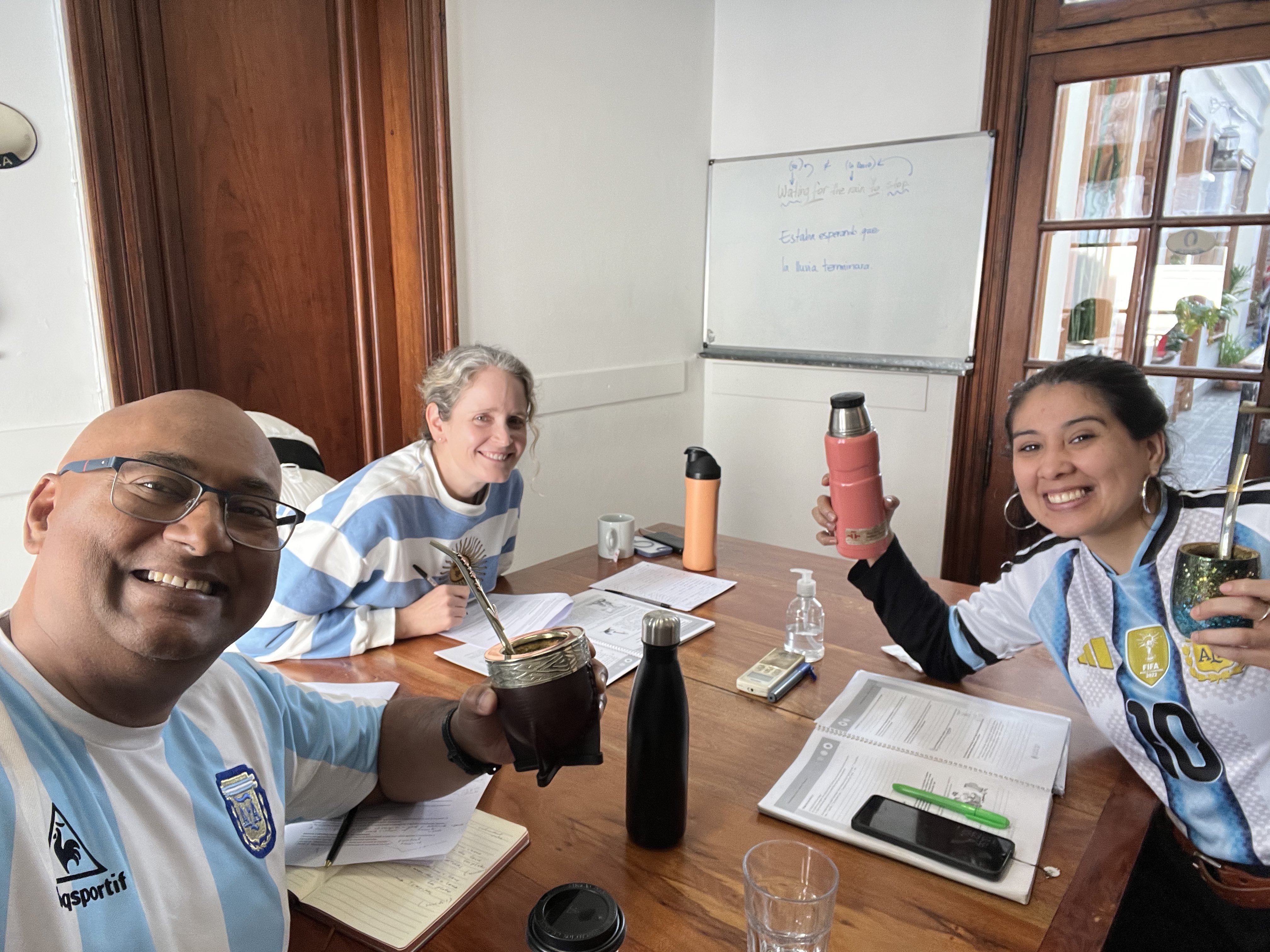
As I start my sabbatical for the rest of the year, I decided to spend the first two weeks brushing up on my Spanish.
My sabbatical project is a multifaceted one that combines studying a musical instrument, the Tabla, teaching Mathematics to disadvantaged students and teaching Yoga in the local community. And the mode of communication for all of these is Spanish.
I primarily chose to learn Tabla as a way to learn more about the connection between math and musical notes and frequencies. With so much math anxiety in schools and universities, teaching Yoga will help me develop skills to keep my own students more relaxed and motivated. And applying all these facets using Spanish as the medium of communication will further enhance my Spanish proficiency, a valuable gain given that Ohlone College has a 24% Latinx population.

My go to place for Spanish instruction is Academia Buenos Aires . These past weeks, I finally advanced to Level C1 – Advanced.
We primarily worked on using the Subjunctive Tense, which seems to be a constant in the Spanish language, appearing all the time. But there was plenty of conversational Spanish and plenty of material to converse about. The World Cup was in full swing and the atmosphere in Buenos Aires was electric.

After a few weeks in Buenos Aires I took a flight to Cordoba (an hour away) and then took a three hour road trip to Los Hornillos, my home base for the Sabbatical.


I then started my Tabla lessons with the Kalabharati School of Dance & Music, which is based in Los Hornillos at the base of Mount Champaqui. I have memorized the first two “Kaida’s” but my teacher Esteban says that we cannot advance unless I rectify certain things (a combination of bad habits and non-synchronized notes). On the flip side my timing and tempo have improved a lot and in this regard, Esteban did not correct me even once (may be it will come later!).
A tabla set consists of a Baya and Daya. The Baya is the one with the larger surface area and there are two main notes for newbies – Ghe Ghe. I know, it sounds like the same note. Both Ghe’s are in fact the same note, but are played with different fingers. I guess the alternating mechanism allows for faster speed? Hopefully I will find out by the end of my sabbatical. The Daya is the one with a smaller surface area and there are four main notes you can play – Na, Thin, Thun and Te Te. Te Te just like Ghe Ghe involves two different sets of fingers.

My Sabbatical project is off to a great start. The next step is for the music school to arrange for me to teach yoga classes and the math classes. In the meantime I have been finding a little more time for my own yoga. The sabbatical is already proving valuable in that I am learning in the midst of finding time to recharge. Stay tuned for more updates by subscribing.


Leave a Reply